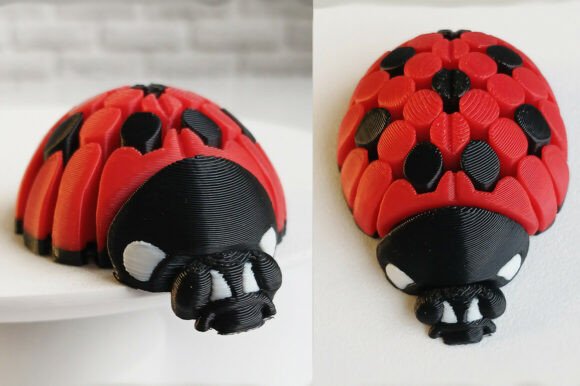
Articulated Ladybug – 3D Flexi Toy 🐞
There is something inherently satisfying about watching a segmented object move with fluid, organic motion. It triggers a small sense of wonder, even in adults who have long since outgrown the need for constant stimulation. This is exactly why the Articulated Ladybug – 3D Flexi Toy 🐞 has become such a popular subject among hobbyists and creators alike. It isn’t just a static figurine; it is a dynamic piece of engineering that bridges the gap between simple plaything and functional fidget tool.
At its core, this model is designed to be printed as a single, continuous piece. There are no tiny screws to lose, no glue to apply, and no frustrating assembly steps that might lead to frustration before you’ve even started using it. The design relies on carefully tuned clearances and clean geometry, allowing the joints to flex immediately after printing. For those who spend their days behind a screen or managing complex projects, having a tactile object that responds to touch can be surprisingly grounding.
More Than Just a Cute Decoration
While the ladybug’s classic red-and-black color scheme makes it visually appealing as a desk ornament, its utility extends far beyond aesthetics. In high-pressure environments, whether that’s a marketing agency during launch week or a classroom during exam prep, small physical interactions can help regulate stress levels. The articulated body allows the toy to bend, wiggle, and curl up into a ball, providing a repetitive motion that helps channel nervous energy.
Consider the scenario of a freelance graphic designer waiting for a large file to render. Instead of mindlessly scrolling through social media, they might pick up their ladybug. The act of extending its legs and watching the segments slide past one another offers a brief mental reset. It is a micro-break that doesn’t require logging off or opening new tabs, keeping the workflow intact while giving the brain a momentary pause.
Practical Applications Across Different Fields
The versatility of the Articulated Ladybug – 3D Flexi Toy 🐞 means it serves different purposes depending on who is holding it. Here is how various groups find value in this simple tool:
- Educators and Teachers: In a classroom setting, these toys serve as excellent rewards for positive behavior or completed assignments. They are inexpensive to produce in bulk if you have access to multiple printers, making them a sustainable alternative to plastic trinkets bought from overseas. Furthermore, teachers can use them to demonstrate basic mechanical principles, such as how linkages work, turning a fun toy into a hands-on learning aid.
- Corporate Gift Givers: For small business owners or entrepreneurs looking for unique corporate gifts, standard branded pens and notebooks often end up in drawers. A 3D-printed articulated ladybug, perhaps customized with a company color or a subtle logo etched into the shell, stands out. It shows attention to detail and supports the maker economy, which resonates well with modern teams.
- Therapists and Counselors: Professionals working with children or individuals with anxiety often look for tools that encourage self-regulation. The smooth movement of the joints provides sensory feedback without being overstimulating. It is a non-verbal tool that can help bridge communication gaps or simply provide comfort during difficult conversations.
- Hobbyists and Makers: For those new to FDM 3D printing, this model is an ideal first project. It teaches the importance of calibration and tolerance settings without the risk of wasting hours on a failed print. Success here builds confidence for more complex models later.
Understanding the Design and Print Process
One of the strongest selling points of this specific model is its "print-in-place" nature. This means the structural integrity of the toy comes from the precision of the print itself rather than post-processing. However, achieving that satisfying wiggle requires paying attention to your settings. While the model is optimized for reliability, every printer behaves slightly differently based on nozzle wear, filament quality, and environmental conditions.
To get the best results, most users find success with a 0.4 mm nozzle and a layer height of 0.16 mm. These settings strike a balance between speed and surface quality. Using a high-quality PLA filament is recommended because it offers the right amount of stiffness and flexibility needed for the joints to hold their shape while still moving smoothly. If the filament is too brittle, the joints may snap; if it is too soft, the toy may not maintain its form.
Temperature management is also critical. Starting with a nozzle temperature of 220 °C and a bed temperature of 65 °C on a textured PEI sheet ensures strong adhesion and proper melting. The textured bed helps prevent warping, which could otherwise misalign the delicate joints. Some users prefer to print with a slight brim to ensure the base stays flat, though many modern slicers handle this automatically.
Customization and Creative Expression
Because the model is digital, it invites creativity. While the traditional red and black pattern is iconic, there is no rule saying you must stick to it. Experimenting with gradient filaments can create a stunning effect, especially when the light catches the curved segments of the back. Imagine a ladybug printed with a sunset gradient of orange fading into deep purple—it becomes a unique piece of art rather than just a toy.
For educators, this opens up opportunities for STEM activities. Students can learn about color theory by mixing filament spools (if using compatible materials) or discuss how different colors affect mood and perception. For marketers, customizing the toy with brand colors reinforces identity in a memorable way. The compact size makes it easy to mail or hand out at events, ensuring your brand remains visible long after the initial interaction.
What to Consider Before Printing
Before you hit the start button, there are a few practical considerations to keep in mind. First, understand that while the joints are designed to be flexible, they are not indestructible. Over-manipulation, especially with excessive force, can eventually weaken the plastic. Encouraging gentle handling, particularly if these toys are intended for younger children, is important for longevity.
Secondly, consider the environment where the toy will be used. PLA, while eco-friendly and easy to print, has a relatively low glass transition temperature. Leaving an articulated ladybug in a hot car on a summer day could cause it to soften and lose its shape. If you live in a warm climate or plan to use the toy outdoors, you might want to explore PETG or ABS alternatives, though these require more advanced printing knowledge due to higher temperatures and potential warping issues.
Finally, think about the audience. If you are printing these for a classroom, consider durability. If they are for personal use as a desk companion, focus on aesthetics and finish. The beauty of 3D printing is the ability to iterate. If the first batch of joints is too tight, adjust your slicer settings to increase clearance slightly. If they are too loose, reduce the tolerance. This trial-and-error process is part of the fun and leads to a deeper understanding of your equipment.
Ultimately, the Articulated Ladybug – 3D Flexi Toy 🐞 is more than just a collection of polygons and vertices. It is a tangible reminder of the possibilities offered by modern manufacturing technology. Whether you are using it to relieve stress during a busy workday, to teach a child about mechanics, or simply to add a touch of whimsy to your workspace, it serves a purpose. By understanding how to print it correctly and appreciating its design, you transform a digital file into a meaningful object that enhances daily life.