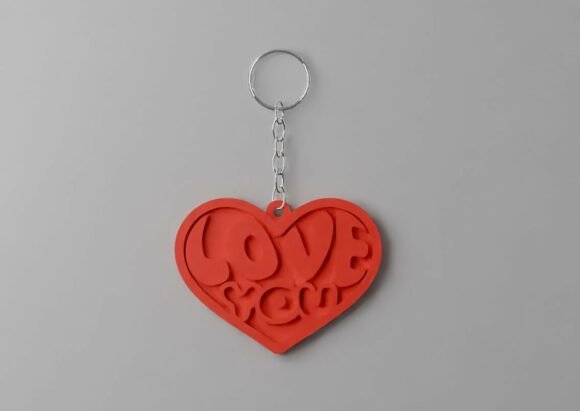
Love You Heart Keychain STL for 3D Print
In a world saturated with mass-produced trinkets, the desire for personalization has never been stronger. Whether you are gifting a token of affection to a partner, creating branded merchandise for your small business, or simply adding a touch of personality to your daily carry items, the Love You Heart Keychain or Charm STL for 3D Print offers a compelling solution. This digital asset is not just a file; it is a bridge between digital creativity and tangible reality, designed specifically for those who value efficiency, quality, and emotional resonance in their projects.
The beauty of this design lies in its accessibility. It removes the steep learning curve often associated with 3D modeling while delivering professional-grade results. For hobbyists and entrepreneurs alike, having access to an error-free, print-ready geometry means less time troubleshooting slicer settings and more time focusing on the creative outcome. This guide explores how to leverage this specific STL file to create meaningful, high-quality physical objects that stand out.
Understanding the Design Philosophy
At its core, the Love You Heart Keychain or Charm STL for 3D Print is engineered for simplicity without sacrificing aesthetic appeal. The phrase "print-in-place" is a technical term that translates directly into user convenience. Unlike traditional models that require separate components to be printed and then glued or snapped together, this design features integrated hinges or flexible joints built directly into the geometry. This means that when the print job finishes, the keychain is ready to use immediately. There is no assembly required, which significantly reduces post-processing time and eliminates the risk of weak glue joints failing under stress.
The geometry is described as clean and high-quality, a critical factor in 3D printing success. Poorly constructed meshes can lead to artifacts, layer shifts, or structural weaknesses. Because this file was created using professional 3D software and tested rigorously, users can trust that the topology is watertight and optimized for additive manufacturing. This reliability is particularly important for beginners who may still be calibrating their printers, as well as for seasoned makers running batch production runs where consistency is paramount.
Creative Applications and Use Cases
While the primary function of this item is to serve as a keychain, its versatility allows for a wide range of applications across different sectors. Understanding these possibilities can help you maximize the value of your digital download.
- Personalized Gifting: The most obvious use case is as a heartfelt gift. The "Love You" message combined with the heart shape is universally understood. However, by varying the filament color, you can tailor the sentiment. A deep red PLA might suit Valentine’s Day, while pastel shades work beautifully for baby showers or birthdays. Consider pairing it with a custom engraving on the back if your printer supports multi-material or post-print customization.
- Small Business Merchandise: Entrepreneurs and Etsy sellers can use this STL as a base for branded goods. While the text is fixed, the charm aspect makes it ideal for attaching to tote bags, laptop sleeves, or promotional notebooks. If you are scaling up, the print-in-place nature allows for rapid prototyping and quick turnaround times, ensuring you can meet customer demand without a backlog of assembly labor.
- Educational Tools: Educators teaching STEM concepts can use this project to demonstrate mechanical principles like living hinges and tolerance spacing. It serves as a practical example of how digital files translate into moving mechanical parts, making abstract engineering concepts tangible for students.
- Event Swag: For wedding planners, party organizers, or corporate event coordinators, these keychains make excellent take-home gifts. They are lightweight, inexpensive to produce in bulk, and carry a positive emotional message that attendees are likely to keep rather than discard.
Technical Execution and Best Practices
To ensure your final product matches the high standards set by the original design, attention to detail during the slicing process is essential. The fact that this file was tested on a Bambu Lab A1 Mini using PLA provides a solid baseline, but adapting these settings to your specific hardware will yield the best results.
Selecting the Right Material
PLA (Polylactic Acid) is the recommended material for several reasons. It is easy to print, biodegradable, and comes in a vast array of colors and finishes. For a keychain that sees daily use, standard PLA is sufficient due to its rigidity. However, if you expect the keychain to undergo significant bending or impact, consider using PETG or TPU (flexible filament). Note that if you switch to flexible filaments, you may need to adjust your retraction settings and print speed to prevent stringing or nozzle clogging.
Slicer Settings for Print-in-Place
The success of a print-in-place model depends heavily on the clearance between moving parts. When slicing your STL, ensure that the infill density is moderate—around 15% to 20%—to provide strength without adding unnecessary weight. More importantly, check the "vertical gap layers" or "separation distance" in your slicer software. This setting determines the air gap between the hinge and the body. If the gap is too small, the parts will fuse together; if it is too large, the movement will feel loose and cheap. Start with the manufacturer’s recommended settings and test print a single unit before committing to a full batch.
Post-Processing for Polish
Even though assembly is not required, minor post-processing can elevate the look of your keychain. Removing support structures (if any are present, though ideally none should be needed for this specific design) can be done with flush cutters. A light sanding with fine-grit sandpaper (220 grit followed by 400 grit) can smooth out layer lines, especially if you are using a matte filament that highlights texture. For a glossy finish, you might consider vapor smoothing, though this requires caution as it can alter the dimensions of the moving parts.
Legal and Ethical Considerations
When purchasing digital assets, it is crucial to respect intellectual property rights. The copyright for this design remains with the creator upon purchase. This typically grants you a license to print and sell physical items made from the file, but it does not transfer the ownership of the digital file itself. Always review the specific terms of service provided by the seller. Generally, you are encouraged to share the joy of your creation by posting photos on social media or blogs, but redistributing the STL file, modifying it to resell, or claiming it as your own original design is strictly prohibited. Adhering to these guidelines supports the ecosystem of independent designers who invest time and skill into creating accessible, high-quality resources.
Conclusion: Empowering Your Creativity
The Love You Heart Keychain or Charm STL for 3D Print represents more than just a downloadable file; it is a tool for expression. By combining ease of use with professional quality, it lowers the barrier to entry for 3D printing while satisfying the demands of experienced makers. Whether you are looking to strengthen personal connections through thoughtful gifts or streamline your production workflow for commercial ventures, this design offers a reliable foundation. As you experiment with colors, materials, and contexts, remember that the true value lies not just in the object itself, but in the intention and care you put into its creation. Embrace the process, test your settings, and let your creativity take shape.