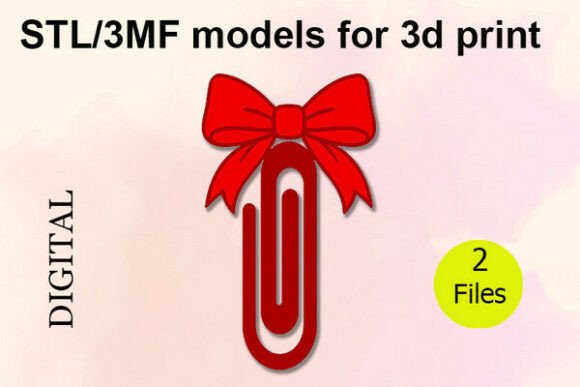
Paper Clips, Bow STL 3MF Files, 3D Print
In the evolving landscape of digital fabrication and personal organization, the intersection of utility and aesthetics has never been more prominent. We are moving away from the era where functional objects were strictly industrial or purely decorative, stepping instead into a period where hybrid items serve both practical needs and emotional expression. This shift is particularly visible in the realm of stationery and office accessories, where small, everyday items like paper clips have transformed into opportunities for creative customization. The release of specialized digital assets, such as Paper Clips, Bow STL 3MF Files, 3D Print, represents a significant step forward for hobbyists, professionals, and creators who seek to personalize their workflows without compromising on efficiency.
The specific product discussed here—a bow-shaped paper clip available in both STL and pre-painted 3MF formats—addresses a growing consumer desire for tangible, high-quality physical products that can be produced locally and instantly. By providing users with ready-to-print files, this digital offering eliminates the barriers of traditional manufacturing, allowing individuals to create unique stationery pieces that reflect their personal style or brand identity. Whether used in a corporate setting to add a touch of warmth to client correspondence or in a personal journal to mark important dates, these printed clips bridge the gap between mass-produced uniformity and bespoke craftsmanship.
The Evolution of Digital Stationery and Personalization
For decades, the design of common office supplies remained largely static. Paper clips were typically simple loops of wire, chosen solely for their ability to hold sheets together without damaging the paper. However, recent trends in lifestyle design, remote work culture, and the "aesthetic" movement on social media platforms have reignited interest in the visual appeal of everyday tools. People are increasingly investing in their physical environments, seeking out desk accessories that bring joy and order to their daily routines. This phenomenon, often referred to as "desk setup culture," highlights a broader psychological need for control and beauty in an increasingly chaotic digital world.
The introduction of 3D printing technology into the mainstream market has accelerated this trend by democratizing access to custom design. Previously, creating a unique paper clip would require access to expensive molding equipment or complex metalworking skills. Today, anyone with a 3D printer can produce intricate designs that were previously impossible to manufacture at a low cost. The availability of Paper Clips, Bow STL 3MF Files, 3D Print allows users to participate in this design revolution, turning a mundane object into a statement piece. This accessibility aligns with the modern preference for sustainability and reduced waste, as users can print only what they need, when they need it, rather than purchasing bulk sets of generic clips that may not fit their aesthetic preferences.
Understanding the Technical Advantages of 3MF and STL Formats
To fully appreciate the value of this digital product, it is essential to understand the technical specifications provided. The package includes two distinct file formats: an STL file and a pre-painted 3MF file. Each serves a different purpose within the 3D printing ecosystem, catering to varying levels of hardware capability and user expertise.
- STL (Stereolithography) File: This is the most widely supported format for 3D printing. It contains geometric data describing the surface of the model but does not include color information. The inclusion of an STL file ensures compatibility with virtually any FDM (Fused Deposition Modeling) or resin printer, regardless of its age or brand. For beginners or those with single-color printers, this file provides a reliable foundation for creating solid-colored bows. The clean design mentioned in the product description suggests that the geometry is optimized for standard slicing software, minimizing errors and ensuring a smooth print process.
- Pre-painted 3MF File: The 3MF format is a newer, more advanced standard developed by the 3MF Consortium. Unlike STL, 3MF supports multiple colors, textures, and materials within a single file. The "pre-painted" aspect of this file is crucial; it means that the color mapping is already defined by the designer. Users with multi-material or full-color 3D printers (such as those utilizing inkjet-based material deposition) can load this file directly and achieve a vibrant, multi-tonal result without needing to manually configure color zones in their slicer. This feature significantly lowers the barrier to entry for achieving professional-looking results, as it removes the guesswork involved in designing color schemes.
This dual-format approach demonstrates a thoughtful consideration of the diverse user base. It acknowledges that while some enthusiasts have invested in high-end, full-color printers, many others rely on affordable, monochrome machines. By providing both options, the creator ensures that the design is accessible to everyone, from casual hobbyists to professional makers.
Design Simplicity and Printability
One of the most critical factors in successful 3D printing, especially for beginners, is the ease of the print job. Complex models often require support structures, which can be time-consuming to remove and may leave unsightly marks on the final product. The bow-shaped paper clip described here is designed as a single solid piece that requires no supports. This design choice is not merely a convenience; it reflects a deep understanding of the mechanics of additive manufacturing.
By avoiding overhangs that necessitate support material, the designer ensures that the internal mechanisms of the paper clip remain unobstructed and fully functional. Supports can sometimes interfere with the springiness or clamping force of a paper clip, rendering it useless. A support-free design guarantees that the printed item will perform its primary function effectively. Furthermore, the lack of supports reduces post-processing time, allowing users to move from print completion to usage almost immediately. This efficiency is highly valued by professionals who view their hobbies as a way to unwind rather than another source of stress.
Additionally, the model’s scalability offers flexibility. In your slicer software, you can freely scale the model to suit your specific needs. If you need a larger clip for thick stacks of documents, you can increase the size proportionally. Conversely, if you prefer a delicate accent for thin journal pages, you can reduce the dimensions. This adaptability makes the file versatile, suitable for a wide range of applications beyond just organizing papers.
Creative Applications and Customization Potential
While the digital files provide the structure, the true magic lies in how users choose to utilize them. The bow shape is inherently symbolic, often associated with gifts, celebrations, and femininity. This makes the paper clip particularly relevant for seasonal events such as Valentine’s Day, weddings, and anniversaries. Imagine using these printed bows to attach gift tags to presents, adding a personalized touch that mass-produced ribbons cannot match. For educators, these clips could serve as engaging rewards for students, combining utility with a sense of achievement.
The product description also notes that after printing, the topper can be decorated manually. This opens up endless possibilities for customization. Users can paint the plastic to match specific color palettes, apply glitter, or add enamel details. This manual finishing step transforms the 3D print from a simple plastic object into a crafted item. For entrepreneurs selling handmade goods, this feature is invaluable. It allows them to offer customizable products where customers can choose their preferred colors or additional embellishments, thereby increasing the perceived value of the final product.
Business Implications and Ethical Usage
For those looking to monetize their 3D printing skills, understanding the licensing terms of digital assets is paramount. The provided guidelines clearly state that users may sell physical products printed from the files, but they must credit the original author. This arrangement supports the creator economy by allowing designers to earn income through digital sales while empowering makers to generate revenue through physical production. It creates a symbiotic relationship where the designer’s intellectual property is respected, and the printer’s labor and material costs are compensated.
Crediting the author is not just a legal requirement; it is a best practice that fosters community trust. In the open-source and maker communities, attribution builds reputation and encourages collaboration. When sellers acknowledge the source of their designs, they contribute to a culture of transparency and respect for creative labor. This ethical approach aligns with broader consumer trends, where buyers are increasingly interested in the stories behind the products they purchase and the values of the businesses they support.
Practical Recommendations for Makers
If you are planning to use these Paper Clips, Bow STL 3MF Files, 3D Print assets, consider the following practical tips to ensure the best results:
- Material Selection: Choose plastics that offer good flexibility and strength. PLA is easy to print and holds detail well, but PETG or TPU might provide better durability for frequently used paper clips. Experimenting with different filaments can yield varying degrees of stiffness and finish.
- Slicer Settings: Even though the model is support-free, adjusting your layer height and infill density can impact the final appearance. A lower layer height will produce smoother surfaces, which is beneficial for the curved bow design. Ensure that your extrusion settings are calibrated correctly to avoid gaps in the thin areas of the clip mechanism.
- Post-Processing: If you are using the STL file and plan to paint the clips, lightly sanding the surface before painting can help the paint adhere better. For the 3MF file, verify that your printer’s color calibration is accurate to ensure the pre-painted colors appear as intended.
- Scaling Considerations: When scaling the model, remember that mechanical properties do not always scale linearly. Making the clip too large might make it heavy or difficult to handle, while making it too small might compromise its structural integrity. Test different scales to find the optimal balance for your intended use case.
The convergence of digital design and physical production continues to reshape how we interact with everyday objects. By providing high-quality, easy-to-use files for bow-shaped paper clips, this resource empowers users to inject personality and creativity into their daily lives. Whether you are a seasoned 3D printing enthusiast or a newcomer eager to explore the capabilities of additive manufacturing, these files offer a straightforward path to creating beautiful, functional art. Embrace the opportunity to customize your world, one clip at a time, and discover the satisfaction of bringing digital ideas into the physical realm.